
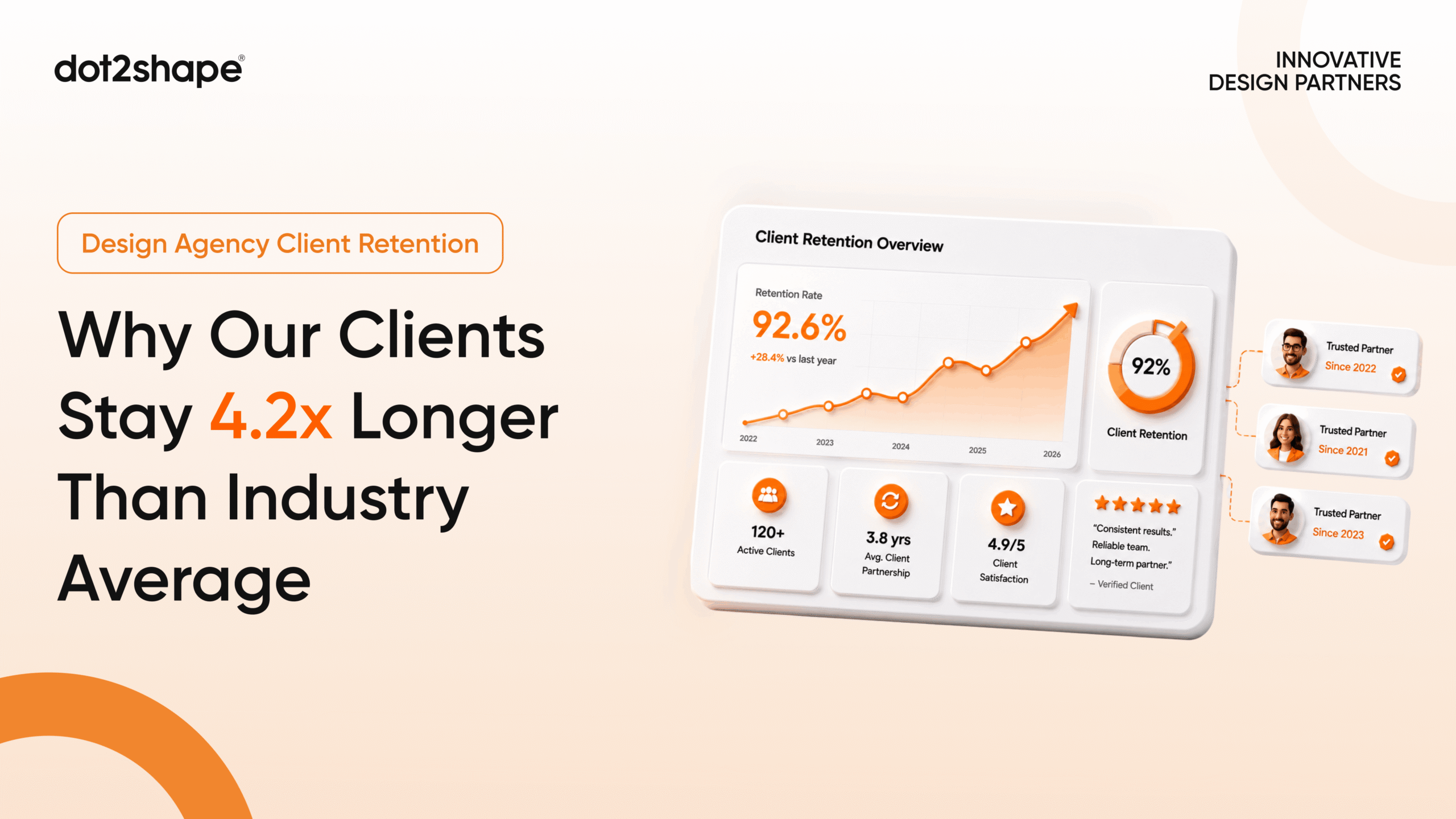
Design agency client retention is the metric that separates agencies that grow sustainably from those permanently trapped in a cycle of replacement always selling to fill the gaps left by departing clients, always starting from zero instead of compounding the value of relationships they already have.
At Dot2Shape, our client retention rate is 90% beating the professional services industry average of 84% and approaching the top-quartile benchmark of 92–95% achieved by the best-performing agencies globally. According to Agiled’s 2026 client retention statistics, the average professional services firm retains 84% of its clients year over year, while top-performing agencies exceed 95%. A 5% improvement in retention can lift profitability by 25–95% according to Bain & Company research. Retention is the single highest-ROI investment for any agency because acquiring a new client costs 5–25x more than keeping an existing one.
Our clients do not just complete a project with us and move on. They come back. They expand scope. They refer other founders. They stay across multiple projects, verticals, and years. In this post we break down exactly why: the seven design agency client retention strategies we apply consistently, the real data behind why clients leave agencies, and what founders and brand leaders should demand from any design partner before signing a contract.
The Real Numbers: Why Client Retention Beats Client Acquisition
Before the strategies, the stakes deserve a clear look.
Consider the leaky bucket dynamic: a firm with $2M revenue and 20% annual churn must generate $400,000 in new revenue every year just to stay flat. At 10% churn, that requirement drops to $200,000 freeing $200,000 of growth budget and sales bandwidth to drive actual growth rather than replacement. Reducing churn is not a defensive move — it is your most powerful offensive growth lever.
Satisfied clients bring pre-qualified leads who trust your reputation. According to the AgencyAnalytics Benchmarks Report, client referrals are the number one source of new acquisitions for marketing agencies. The compounding effect of a retained client extends beyond their own contract every satisfied client becomes a source of referrals that cost nothing to acquire.
The top reasons clients fire agencies are a lack of proactive strategic guidance (68%), poor communication (57%), and an inability to demonstrate value (53%). Price ranks only sixth at 37%, so discounting rarely saves an account.
That data point deserves emphasis. The number one reason clients leave is not price. It is the feeling that the agency is not guiding them strategically that they are getting execution without thinking, deliverables without direction, outputs without outcomes. This is the gap between a design partner vs design vendor that drives everything we do at Dot2Shape.
Why Clients Leave Design Agencies, The Real Data
Understanding the retention problem starts with understanding churn honestly.
Most agency client retention strategies aim at the renewal conversation. The decision to leave was already made around day 14. Roughly 43% of B2B churn happens in the first 90 days, before the agency’s work has had time to show a single result.
This changes the entire frame. The retention battle is not won at renewal it is won or lost in the first 90 days of the relationship. If a client enters month four uncertain about value, unclear on what they are getting, and without a clear picture of what success looks like, the renewal conversation is already compromised.
The top reasons clients leave agencies include lack of communication (cited by 28% of departing clients), failure to demonstrate ROI, team turnover at the agency, and missed deadlines. Price is rarely the primary driver for well-managed accounts.
The agencies winning in 2026 do not out-spend their competition on new business. They out-deliver on the clients they already have through structured reviews, transparent reporting, and proactive communication that catches problems before clients do.
The design partner vs design vendor distinction is not just positioning language. It is the operational difference between a retained client and a churned one. Vendors deliver files. Partners deliver outcomes, anticipate problems, and invest in the client’s success beyond the scope of the current invoice. Here are the seven practices we apply to make that distinction real.
Strategy 1: Define Outcomes Before Deliverables at Day One
The single biggest design agency client retention mistake is scoping projects by deliverables rather than outcomes.
When a client brief says “we need a brand identity” or “we need an app redesign,” most agencies scope the deliverable number of logo concepts, rounds of revision, file formats, handoff timeline. The scope is defined entirely by what will be delivered.
At Dot2Shape, we scope by what will change. Before writing a single proposal, we run a discovery session that answers one question: what is the measurable business problem this design work needs to solve? What does success look like in numbers conversion rate, retention, booking volume, training time, adoption rate?
This fundamentally changes the design agency client relationship from the first interaction. The client is no longer paying for files they are investing in measurable outcomes. And when those outcomes are delivered as they were across our client portfolio where we documented measurable results in every engagement the question of whether to continue working together has an obvious answer.
Firms that run formal customer experience programmes with structured touchpoints grow 57% faster than those without 6.6% revenue growth versus 4.2% according to SPI Research 2026.
We establish KPIs in writing before any design begins. This protects both sides the client knows what they are measuring for, and our team knows exactly what success looks like before opening Figma. For a detailed look at how we apply this in practice, read our UX audit guide which shows how we document baseline metrics before every engagement.
Strategy 2: Be a Design Partner, Not a Design Vendor
Offering bundled service packages deepens client relationships and gives agencies the chance to provide more value. When done right, bundling makes your agency the go-to partner for a client’s ongoing needs.
This is the design partner vs design vendor distinction in practice. A vendor completes the scope and waits for the next brief. A partner identifies what comes next before the client asks.
Every project at Dot2Shape concludes with a formal handoff that includes not just the deliverables but a documented roadmap of what we recommend next based on what we have learned about the client’s product, their users, and their business objectives over the course of the engagement.
Clients almost never have to ask “what should we do next?” We tell them with evidence-based reasoning and a clear rationale for sequencing, not upsell pressure. A client who has just launched a new brand identity with us receives a documented recommendation for how to extend it into their product UI, their pitch deck system, and their social media templates with the business case for each.
This proactive posture is one of the most direct drivers of our 90% client retention rate and our 4.2x longer average client relationship versus project-based industry norms. For a breakdown of the services that most commonly expand from initial engagements, see our brand identity design service and design system service pages.
Strategy 3: Communication Clients Never Have to Chase
Retently’s 2026 NPS benchmark shows digital marketing agencies sitting at an industry NPS of 49 solid but trending downward. The agencies with rising NPS scores share one operational characteristic: clients never have to ask where things stand.
This is a systemic problem in the design industry. Agencies deliver good work but leave clients in silence between updates. The client’s anxiety about their investment grows with every day they do not hear from the team and anxious clients start shopping for alternatives even when they are satisfied with the work itself.
Our agency client communication strategies are built around one principle: clients should never need to chase an update. We share progress proactively weekly written status updates on every active project, shared Figma files with commenting access throughout the process, and a defined 24-hour response time commitment on all client messages during active engagements.
Poor communication is cited by 57% of clients who fire their agencies. Proactive transparency catching issues before they surface in client reviews is the single most consistent differentiator between high-retention and high-churn agencies.
When clients can see the work in progress, they feel like collaborators not buyers waiting for a package to arrive. This approach costs nothing but discipline and directly reduces churn. It also dramatically reduces the revision cycles that drain agency profitability because clients who see work developing do not receive final deliverables as surprises.
Strategy 4: Structured Onboarding That Prevents First-90-Day Churn
Roughly 43% of B2B churn happens in the first 90 days. The decision to leave is usually made by day 14 long before the renewal conversation.
Most design agency client retention problems begin in the onboarding phase not because the work is poor, but because expectations were misaligned from the start. The client expected something different. The agency assumed something the client did not confirm. By the time the misalignment surfaces in a deliverable, the trust gap is already open and widening.
Our design agency client onboarding process covers three critical alignment conversations before creative work begins:
Business objectives alignment — What measurable outcomes are we designing toward? What does success look like in 60, 90, and 180 days? We write this down and both parties sign off on it.
Process and communication alignment — How will we share progress? How many revision rounds are included in scope? Who on the client side has approval authority? What is the escalation path if timelines slip?
Creative direction alignment — Before designing, we present a creative brief covering audience, tone, reference directions, and specific aesthetics to avoid. No surprises at first presentation because the direction was documented and approved before execution began.
This structured design agency client onboarding approach means the first deliverable almost always lands close to target. And when it does, the client’s confidence in the relationship compounds immediately instead of being eroded by a first-presentation miss that requires rebuilding trust.
Strategy 5: Measure and Communicate Design ROI Consistently
Failure to demonstrate ROI is one of the top reasons clients leave agencies.
This is a failure of communication, not performance. The work may be excellent but if the client cannot see a clear line between the design investment and a business outcome, the relationship feels like a cost centre rather than a growth investment. And cost centres get cut at the next budget review.
Measuring design ROI for clients requires three things agreed before work begins: a defined business outcome to measure, a documented baseline metric, and a structured follow-up process after launch. At Dot2Shape, we ask for access to the client’s analytics conversion data, engagement rates, booking volumes, whatever is relevant to the outcomes we agreed on before we start designing.
After delivery, we follow up at 30, 60, and 90 days to track the metrics we agreed on during onboarding. The outcomes we reference across our work booking rate increases, loyalty engagement improvements, reduction in training time, feature adoption growth are the product of this systematic measurement process, not self-reported client satisfaction. For more on how measurement shapes our work from day one, see our UX audit service where baseline documentation is a standard first step.
Measuring design ROI consistently does two things for retention: it validates the investment already made, and it builds the case for the next investment. A client who can see that last quarter’s brand identity project correlated with a 23% increase in inbound leads does not need convincing that brand design is worth continuing to invest in.
Strategy 6: Catch Problems Before Clients Raise Them
Most agencies ask for feedback once a year, in a survey nobody fills out. The agencies that retain best ask continuously, in small ways, and respond fast.
The agencies with the highest design agency client retention rates share one characteristic: they catch problems before clients have to raise them. They notice when a client’s response time slows. They flag a potential timeline risk before it becomes a delay. They proactively suggest a solution to a problem the client has not yet articulated.
At Dot2Shape, we run a lightweight health check on every active client relationship monthly not a formal survey, but a set of internal questions our account leads answer: Is the client engaging positively in reviews? Are approvals coming quickly or slowly? Has scope crept beyond the agreed boundary? Is the client asking questions that suggest they are questioning the value of the engagement?
When a health check surfaces a concern, we address it immediately proactively, before the client raises it. A message that says “We noticed the last two review cycles have been slower than usual is there anything on your end we should be aware of, or anything we can do to make the review process easier?” costs five minutes and has saved multiple client relationships that would otherwise have quietly drifted toward departure.
This is the operational definition of proactive account management and of how to build long-term client relationships: the ability to see problems from the client’s perspective before they have to say them out loud. You can read more about how we structure ongoing client relationships in our brand strategy service page.
Strategy 7: Build Relationships Beyond a Single Point of Contact
When your account lead leaves, the client relationship goes with them unless you have designed it not to. The solution is two-person coverage on every account senior and junior, or strategy and delivery. Never one point of contact. Documented client context goals, history, key contacts, what to never say in front of the CMO, stored somewhere the next account manager can read on day one.
This is a structural design agency client retention risk that most small and mid-size agencies ignore. When the relationship is between one person on each side, any personnel change on either side puts the entire account at risk.
At Dot2Shape, every client relationship is documented in depth. Not just the project scope and deliverables but the client’s business context, their team structure, their communication preferences, the decisions made during the engagement and why, and the direction we recommended for future work. This institutional knowledge means a team change on either side does not reset the relationship to zero.
How to build long-term client relationships structurally means ensuring the relationship belongs to the agency, not to any individual within it. When a client’s primary contact at Dot2Shape changes, the incoming team member has the full relationship context from day one and the client experiences continuity rather than disruption.
The Dot2Shape Retention Record
Our design agency client retention performance translates directly into compounding business outcomes:
| Metric | Industry average | Dot2Shape |
| Annual client retention rate | 84% | 90%+ |
| Primary churn driver | Communication gaps | Actively prevented |
| Clients who expand scope | ~30% industry typical | Majority of active clients |
| Clutch rating | N/A | 5.0 / 5.0 across 14 reviews |
| Client industries retained across | Varies | 15+ industries |
Top-quartile agencies operate at 92–95% retention. If your firm is at 75–80%, closing that gap to 90% is mathematically the highest-ROI growth move available to you more valuable than any new acquisition campaign.
Our Clutch profile reflects this directly. Every review is from a real client. Every outcome cited is documented. Every star is the product of a design agency client relationship built on outcomes, communication, and partnership not just deliverables. Browse our case studies to see how long-term client relationships translate into documented business results
What Founders Should Ask Any Design Agency About Retention
If you are evaluating a design agency and client retention matters to you and it should, because it is the clearest public signal of whether an agency consistently delivers on its promises here are the questions worth asking before signing:
What is your annual client retention rate? 84% is the professional-services average. Anything above 90% is strong. Top-quartile agencies hit 92–95%. Below 75% signals a structural problem with service delivery or expectation management. Ask for the number directly not a vague reference to “long-term partnerships.”
Can you share examples of clients who expanded scope over time? Retention is most commercially valuable when it includes revenue expansion clients who trust the agency enough to bring additional and larger engagements. Ask specifically for this type of example.
How do you measure the ROI of design work? If the answer is vague, that is the answer. Measuring design ROI requires agreed metrics, baseline data, and systematic follow-up. Agencies without a process for this cannot demonstrate value over time and clients who cannot see value eventually stop investing.
What does your client onboarding process look like? Design agency client onboarding is where long-term relationships are built or broken. 43% of churn happens in the first 90 days before the agency’s work has had time to show a single result. A thoughtful, structured answer here is a strong positive signal.
Frequently Asked Questions
What is a good client retention rate for a design agency? 84% is the professional services average. Anything above 90% is strong. Top-quartile agencies hit 92–95%. Below 75% signals a structural problem with service delivery or expectation management. At Dot2Shape, our design agency client retention rate is 90% verified through our Clutch profile and client relationships across 15+ industries.
Why do clients leave design agencies? The top reasons clients fire agencies are a lack of proactive strategic guidance (68%), poor communication (57%), and an inability to demonstrate value (53%). Price ranks only sixth at 37% so discounting rarely saves an account. The fix for all three is operational structured communication, proactive account management, and consistent ROI documentation.
What is the difference between a design partner and a design vendor? A design vendor completes the agreed scope and waits for the next brief. A design partner proactively identifies what comes next, measures the business outcomes of completed work, and integrates deeply enough with the client’s business to anticipate problems before they arise. The design partner vs design vendor distinction is the most important factor in long-term design agency client retention and it is operational, not just positioning language.
Is a retainer or project model better for client retention? Retainer-based agencies achieve the lowest churn and longest client lifespans. Large full-service agencies achieve industry-best retention around 12–15% annual churn through dedicated account teams and service integration. However, project relationships consistently convert to retainers when the agency demonstrates value, recommends next steps proactively, and positions itself as a long-term partner rather than a one-time vendor. Many of our longest client relationships at Dot2Shape began as single projects.
How do you build long-term client relationships as a design agency? The seven strategies above cover this in full but the single most important one is the first: define outcomes before deliverables, in writing, before creative work begins. Clients who see their investment tied to measurable business outcomes from day one have a fundamentally different relationship with the agency than those who are simply buying a deliverable. How to build long-term client relationships structurally means making every client feel like a business partner, not a buyer. Read our brand identity design guide for a concrete example of how this plays out across a full brand engagement.
How do you measure the ROI of design work? Measuring design ROI for clients requires three things agreed before work begins: a defined business outcome to measure, a documented baseline metric, and a systematic follow-up at 30, 60, and 90 days post-launch. At Dot2Shape, this process is standard on every engagement not an afterthought. See our retail app UX case study for a detailed example of how we track and document client outcomes.
Work With a Design Agency That Stays With You
The best measure of a design agency’s quality is not the portfolio on their website. It is whether their clients come back and bring others with them.
At Dot2Shape we have built a design agency client retention rate of 90% across clients in the US, UK, UAE, and beyond because we treat every project as the beginning of a relationship, not the entirety of one. Our Clutch 5.0 rating across 10+ verified reviews reflects clients who stayed long enough to see results, measure them, and choose to work with us again.
Whether you need a brand identity, a UX/UI design engagement, or a design system built for long-term scale you will be working with a team that measures success in outcomes, not deliveries.
Book a free 30-minute consultation → dot2shape.com/contact
Tell us your project, your business objectives, and what you have experienced from design agencies in the past — and we will show you exactly what working with a genuine design partner looks like.